

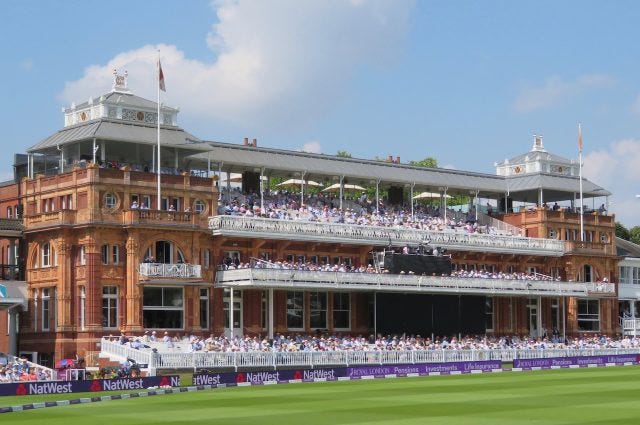
The Marylebone Cricket Club, at Lord’s Cricket Ground. (Photo credit: afaranwide.com.)
What does a club do when one of its members has a very high-profile fall from grace? This issue has recently come up with the Savage Club’s decision to expel Andrew Mountbatten-Windsor; and I was reminded of it again with the death of Jeffrey Archer last week.
The response taken by a club obviously depends entirely on the circumstances of the fall from grace. Minor matters might be deemed entirely personal, and/or to have nothing to do with a social club. Or it may be deemed very serious indeed. And unlike many such cases which happen behind closed doors, Jeffrey Archer’s exclusion from the Marylebone Cricket Club at Lord’s Cricket Ground was well-documented.
The MCC did not act particularly quickly: there was a gap of nearly three years between Archer’s very public disgrace in November 1999, and his exclusion from the Club in October 2002. Lord Archer had long had a certain reputation — a loveable rogue, according to his friends; and an incorrigible liar, fraudster, embezzler, thief, insider trader and fabulist, according to those who took a less charitable view.
Clubland outsider
Archer had never been a staple of Clubland — despite a political career stretching back to the 1960s with terms served in the GLC, House of Commons and House of Lords, he never joined any of the political clubs; not even the Carlton Club, which traditionally offers a year’s complementary membership to newly-elected Tory MPs. But then, his entry into Parliament in a 1969 by-election was regarded with some suspicion, as the former Tory MP Humphry Berkeley had very publicly sought to have Archer blocked as a candidate, as “unsuitable.” (Berkeley later elaborated that when he had been Chairman of the United Nations Association, Archer had been caught fiddling his expenses — not the first time, or the last, that Archer would be accused of embezzling money from a registered charity, with similar accusations from Oxfam, and a police probe into his Kurdish refugee appeal. Then as now, word can get out among clubs about this sort of thing, making it very difficult for people to join, even if the accusation proves unfounded.)

Archer playing cricket for the Lords Taverners in Cambridge, in 1987 - the year of his libel victory.
Archer, Cricketer
While he was not elected to any of the major central London clubs, Archer was always a cricketing fanatic - his Who’s Who entry listed interests including, “watching Somerset try to win the County Championship.” And so in the late 1980s, he became a long-standing member of the Marylebone Cricket Club, the “home of English cricket” which then had over 18,000 full members, and a formidable waiting list of over 20 years. (The latter of which, Archer appears to have side-stepped.)
And once he had been elected, he made little secret of his MCC membership, advertising it to all who would listen. The first public reference to Archer’s MCC membership came in May 1991, when he spoke to the Cambridge Daily News in favour of the Club admitting women. He later announced that he had spent thousands of pounds buying turf from Lord’s Cricket Ground, to relay his garden in Grantchester. And as a member, Archer became a regular fixture at Lord’s Cricket Ground.
Disgrace
On 20th November 1999, Archer sensationally quit as the Conservative Party’s candidate to be the first directly-elected Mayor of London. This followed testimony from an estranged friend, Ted Francis, that he had been asked by Archer to lie under oath, giving Archer a false alibi in his successful 1987 libel action against the Daily Star, which had resulted in a then-record £500,000 libel payout to Archer — over a story that turned out to be entirely true. Although Archer’s public disgrace was immediate (and in February 2000 he was formally expelled from the Conservative Party for five years), it was not until April 2000 that he was arrested; and in July 2001, he was sentenced to four years’ imprisonment for perjury.
The Marylebone Cricket Club did not immediately see these events as being any of their business, and for the first year of Archer’s jail sentence, there was no response from the Club. As far as they were concerned, he remained a member in good standing, with the best-selling multi-millionaire novelist still paying his subscription. Indeed, even as a prison inmate, he remained an avowed cricketing enthusiast, umpiring a match at HMP North Sea Camp in Lincolnshire between the prisoners and locals.
However, the larger the Club, the harder it is to hush up a case such as this, and over the ensuing year, several concerned members reportedly contacted the Committee, asking variations on, “Is Jeffrey Archer still a member?”
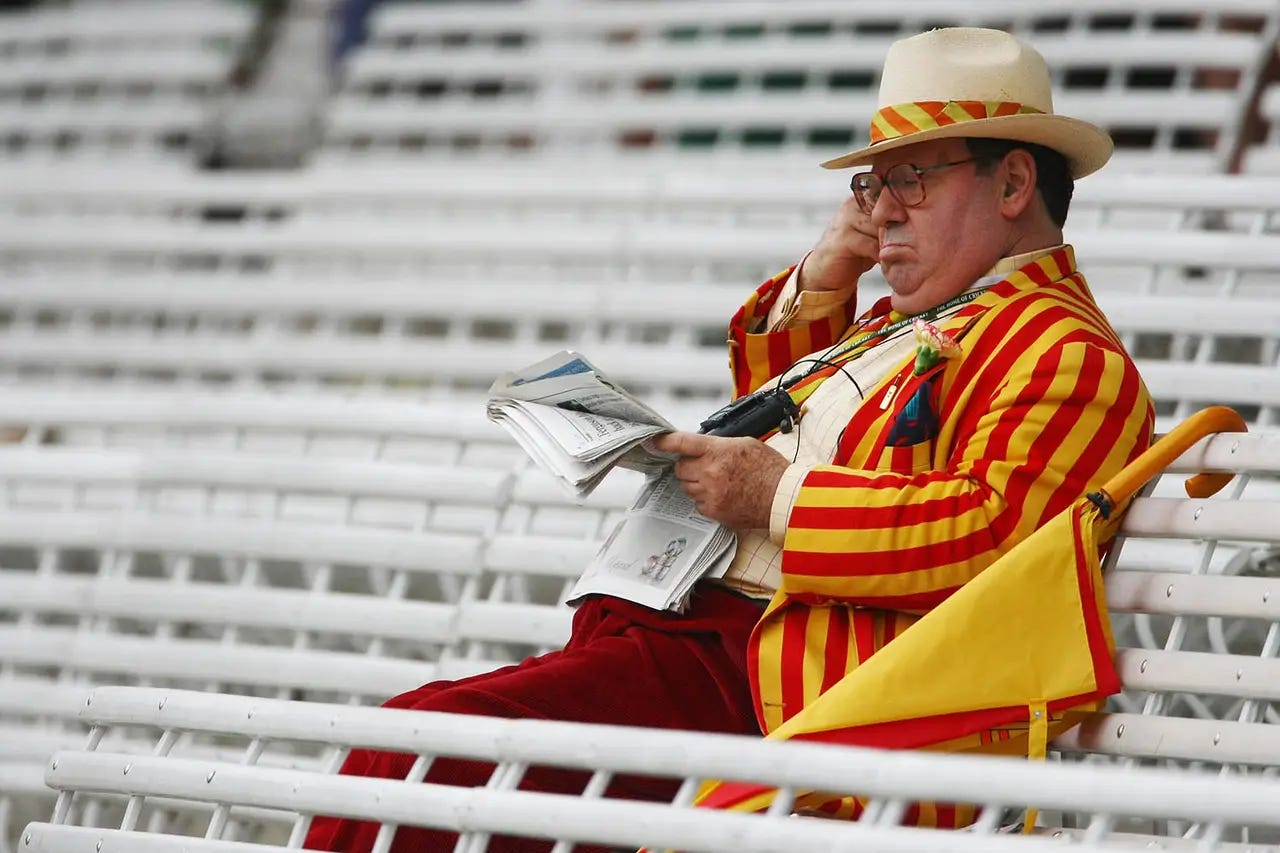
Fingers: apparently “delighted” at Archer’s prison sentence. (Photo credit: The Observer.)
Others had reasons of their own for not holding Archer in the highest regard. Patrick Kidd’s obituary for MCC stalwart John “Fingers” Fingleton notes that the charity auctioneer “was said to have been delighted when Jeffrey Archer went to prison as it removed his main rival.”
But opinion among MCC members was by no means united around expelling Archer. Even some political opponents thought he should remain, like Gordon Brown’s former press secretary Charlie Whelan, who commented, “I have no love for Jeffrey Archer, but I don’t think he should be kicked out of the club. If he does the porridge, he shouldn’t be booted out.”
And the Committee had not — despite their public silence — avoided discussing the issue altogether. Instead, they had agreed that with Lord Archer appealing both his conviction, and his four-year sentence, he should be given a chance to pursue these avenues. Both appeals lasted a year. On 22 July 2002, Lord Justice Rose, alongside Mr. Justice Colman and Mr. Justice Stanley Burnton, dismissed Archer’s appeal within hours of the hearing.
With Lord Archer having run out of road in his appeals against imprisonment, this raised a number of awkward questions for the MCC’s 20-strong Committee. For one thing, there was no sign of Archer resigning from the Club of his own volition — on the contrary, even though he was in prison, he had fully paid up his 2002 subscription. There was at the time no precedent in living memory for the Club’s Committee expelling a member — the last known case had been the expulsion of William Lambert in 1817, over a match-fixing and betting scandal. To make things more awkward, several members of the Committee knew Archer personally — this included the former Prime Minister Sir John Major, who had given Archer his peerage in 1992, over-ruling objections and an attempted veto by the Political Honours Scrutiny Committee. Another member who had a more obvious conflict of interest was the Committee’s Chairman, Lord Alexander of Weedon, who had previously acted for Archer as his barrister in his 1987 libel trial against the Daily Star. Alexander recused himself from the discussions, handing over the chair to former England cricket captain Ted Dexter.
What to do?
As an initial step, Archer was excluded from the Lord’s Taverners charity cricket club — but though historically linked to the MCC, this was an entirely independent institution.
With Archer’s membership under discussion, and Archer having limited contact with the outside world, a friend of his at the MCC, Chris Beetles, lobbied the Committee on his behalf. Beetles later told the Sunday Telegraph:
“I think the Committee, which has the interests of cricket at heart, will realise that Jeffrey also has the interests of cricket at heart. This is one area of his life where he has been absolutely blameless. I am confident he will win the day because of how he is regarded in cricket.”
The matter of Archer’s MCC membership was first referred to the Club’s Membership Sub-Committee, chaired by veteran cricketer Charles Fry. The Guardian noted that he was, “grandson of C. B. Fry, who captained England and was once offered the kingdom of Albania. If anyone is capable of turning in his grave, it is Mr Fry.” They recommended to the Committee that Archer be asked to resign.
In September 2002, the Committee wrote to Archer — he was then an inmate of HMP North Sea Camp, an open prison in Lincolnshire. They informed him that his conviction and ongoing jail term, recently confirmed in the appeal ruling, were incompatible with the requirement for members to uphold the good name of the Club. In light of this, the letter reportedly “asked him to justify his membership and offered a dignified exit,” through offering his resignation.
Later that month, Archer wrote back from HMP Lincoln, a Category-B Prison where he had just been moved after breaking the rules of his day release from his previous open prison. He wrote to Roger Knight, the Club’s Secretary and Chief Executive, and to Sir Tim Rice, the Club’s President. Archer refused to offer his resignation from the MCC, pleading to not be expelled. His letter reportedly “expressed his love and commitment to the game and the club.” Several former England cricketers also wrote letters of support for Archer, to the Committee.
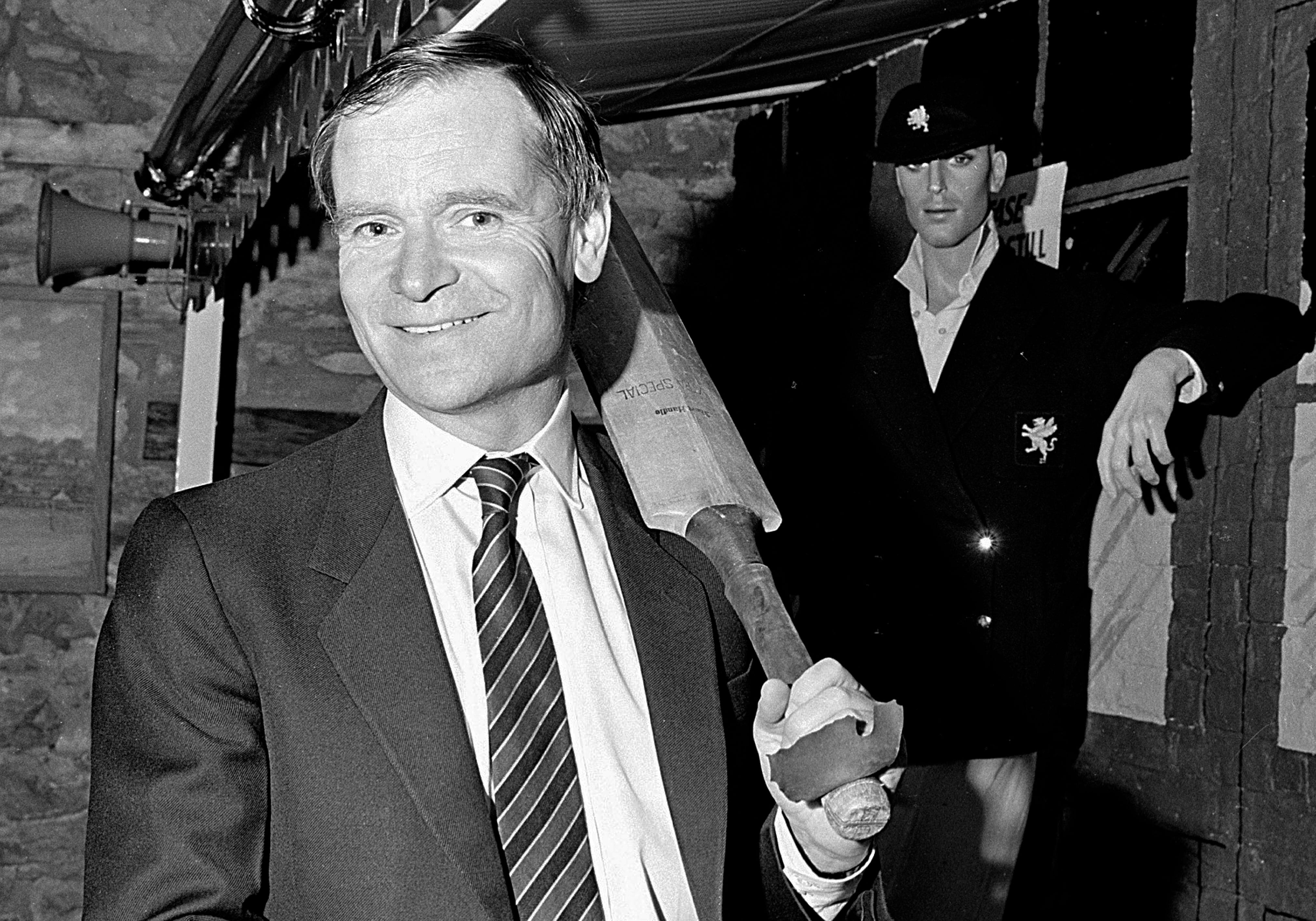
Cricketing enthusiast Jeffrey Archer. (Photo credit: Wellington Weekly News.)
The story goes public
On Sunday 20th October 2002, three days before the Committee was due to decide Archer’s fate, the story was broken by the Sunday Telegraph, which reported:
Jeffrey Archer has written an impassioned letter from prison to Marylebone Cricket Club pleading against his expulsion as a member despite his conviction for perjury and perverting the course of justice . . .
The Telegraph can reveal that in his letter to the committee Archer, 62, seeks to justify why he should remain a member of the MCC, the private members’ club founded in 1787 to set up a new cricket ground for London’s noblemen and aristocrats . . . Archer writes in his letter about his love and commitment to the game and the club. He has regularly been involved in fundraising on behalf of the MCC and county cricketers . . .
He was jailed in July last year for perjury and perverting the course of justice over his 1987 libel case with the Daily Star, which accused him of having sex with Monica Coghlan, a prostitute. Nothing in the MCC’s rules requires the expulsion of a member who has been convicted of a crime, but all members are required to uphold the good name of the club.
Restauranteur Paul Clerehugh wrote in the Reading Evening Post that:
“Archer really doesn’t appear to appreciate that he has done anything wrong, and not letting him back into the cricket club will at least indicate to him that he has.”
The MCC’s decision
On Wednesday 23rd October 2002, the Club’s Committee discussed Archer’s case, and reached a verdict. They stopped short of expelling him altogether, but instead suspended his membership for seven years, with immediate effect. A source on the Committee told India Abroad, “that the mood of the meeting was to expel Archer, but he escaped that extra punishment by just one vote.”
The MCC’s seven-year suspension ended up being a considerably longer sentence than Archer’s criminal conviction, for which he served two years of his four-year jail sentence.
In a press statement, the Club confirmed, “A letter was sent to Lord Archer, on Wednesday afternoon, informing him of this decision.” While this move fell short of outright expulsion, it was believed to be the first exclusion of an MCC member in modern times.
Archer reportedly told friends he was “deeply disappointed” by the decision. His friend Chris Beetles told the Daily Telegraph that he believed:
“This is a vindictive judgment on a man who has been good for cricket and loves his cricket. It is highly unlikely to represent the views of the majority of cricket-loving MCC members.”
Archer’s own account of his suspension, in his published prison diary, is as misleading as anything else written by the man. His short entry for “Day 287, Wednesday 1 May 2002” notes:
“I was president of the World Snooker Association until I was arrested, when the board asked me to resign. Two other bodies expelled me, the Royal Society of Arts and the MCC.”
Of course, this diary entry (presumably written later) was dated four months before the MCC first contacted Archer about the matter; and in the end, he was suspended, not “expelled”, as he claimed. Under the circumstances — and given the much harsher verdict of the World Snooker Association — he might be thought to have gotten off lightly with the MCC.
When Archer was interviewed by the journalist Helen Cummins in 2009, she asked him whether the he would return to the Club after his suspension was lifted later in the year. “Presumably,” was his short answer. In the end, he resumed being a regular fixture at Lord’s. Indeed, in later years, Archer would tweet about the MCC, sharing with his readers its club colours (which he had been forbidden from wearing during his suspension):


Even once Archer had ‘done his time’ with the Club, some ill feeling remained, and his later visits caused disquiet among his more propriety-minded colleagues. One member, Michael Geliot, told the Evening Standard in 2012, “He’s not the sort of guy we want around.”
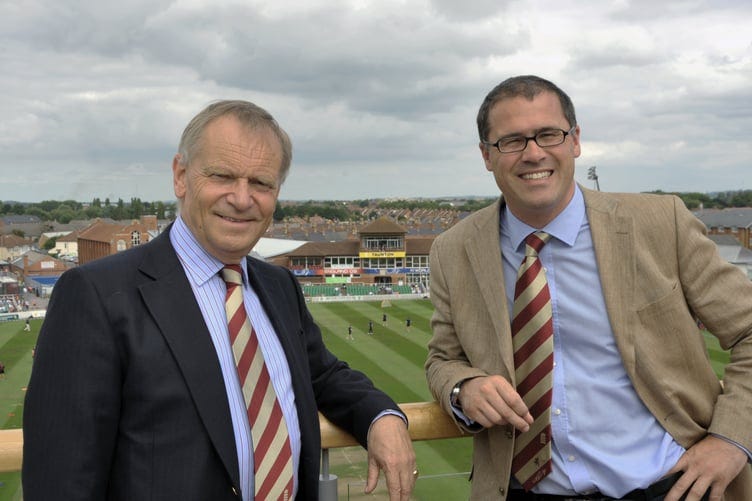
Lord Archer (left) pictured at Somerset County Cricket Club, with its chief executive Richard Gould (right) in 2008. (Photo credit: West Somerset Free Press/Alain Lockyer.)
(Full declaration of interest, I used to be a research assistant for Lord Archer’s long-time nemesis, the journalist Michael Crick, whose very unauthorised 1995 Archer biography, Stranger Than Fiction, makes compelling reading, and is well worth a look.)
You can view the full and varied backlog of Clubland Substack articles, by clicking on the index below.
Index
Articles are centred around several distinct strands, so the below contains links to the main pieces, sorted by theme.
Good piece - thank-you.
Well, Archer may not have been selected to play cricket for England, he would surely have been one of the first names on the squad list to represent GB at the Chutzpah Olympiad.
As an aside, has any member of another gentlemen’s worn their club colours quite as enthusiastically as Fingers?